Milepost 15: What Becomes of the Broken Hearted
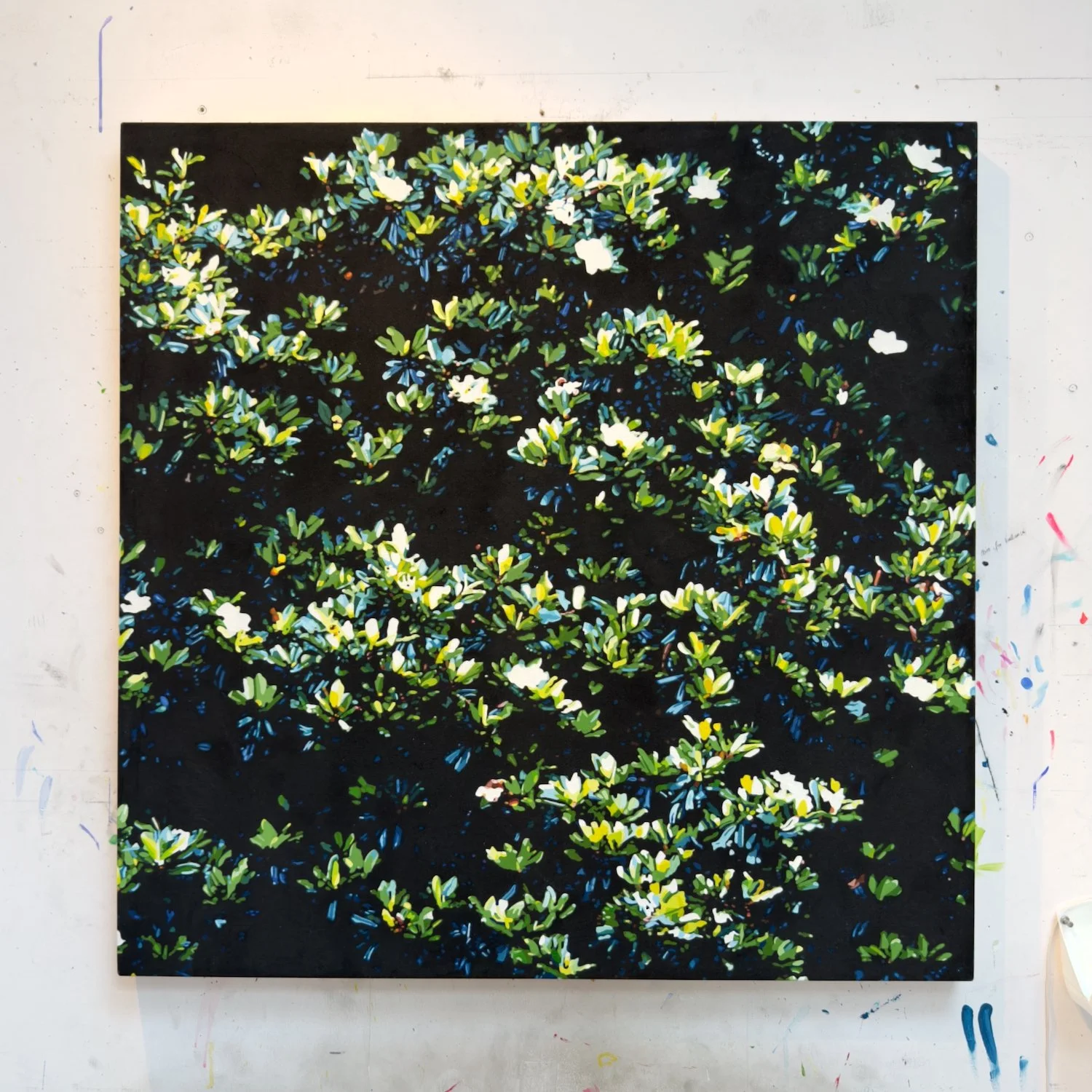
Magnolia, I
charcoal & acrylic on canvas
36” x 36”
2025
“The woods on the bluff are the hardwood trees—dark and berried and flowered. The magnolia is the spectacular one with its heavy cups—they look heavy as silver—weighing upon its aromatic, elliptical, black-green leaves, or when it bears its dense pink cones. I remember in an old botany book, written long ago in England, reporting the magnolia by hearsay, as having blossoms “so large as to be distinctly visible a mile or more—seen in the mass, we presume.” But I tested the visibility of the magnolia, and the single flower can be seen for several miles on a clear day.
Eudora Welty, “Some Notes on River Country”
Mortifyingly cliché as it sounds, hear me out. I’m working up to something here…
Picture it, a magnolia growing in front of a burned-out antebellum mansion here in town on a site well known amongst locals, preservationists, and adventure-seeking teens, often reappearing on Mississippi’s Most-Endangered Historic Properties list, year after year. Part of the local landscape since 1819 (-ish), Arlington represents one of Natchez’s early suburban villas, surviving largely because it was topped with a new roof following the fire that gutted it in 2002. The hope was that it would enable the owner to save the structure, but that’s not what happened. Now it just sits like some southern gothic monument, long since stripped of its marble mantels, decorative plaster, and nineteenth-century hardware by opportunistic, midnight scavengers, regularly popping up in YouTube videos filmed and posted by trespassers with a taste for decay.
Over the summer, I found myself passing the site four mornings a week on my way to and fro the county pool on the bypass over by the terminus of the Natchez Trace, our National Scenic Parkway. Part of my weekly routine for more than a decade, I’ve been lap swimming in the tiled basement pool of one of the local victorian schoolhouses, Carpenter II, currently in use as the Natchez Senior Citizens Center. Alas, I’m no merman or great physical male specimen, but what I lack in prowess I make up for with sincere enthusiasm. I’ve always loved the water and find that it does as much for the mind as it does for the body.
But tragically, the one hundred and twelve year old pool sprang a leak back in March and has been dry for the first time since World War II when it was used as a pen to raise hogs for the war effort. Presently, the fate of the pool and its aquatic senior citizens is unknown as the costs for repair are likely too great with so much need elsewhere in the community.
As an alternative, the city of Natchez kindly made available two hours at the county pool Tuesday through Friday before their daily 8am opening. So beginning in June, I was rising at 5am to swim laps at 6am, passing the burned out shell of Arlington pre and post swim clear through September.
The outdoor facility is relatively new, featuring eight swim lanes alongside a zero-entry shallow end with various jets and fountains, a stark contrast to the tiled basement pool of the victorian schoolhouse. It’s a very nice facility, though it’s in need of some TLC and a good custodian, but over all, it was a great experience. Seeing the sun rise through the bleachers of Natchez High’s football field was the cherry on top of a busy summer.
Formerly swimming in the evenings, the most I ever encountered was a couple older men doing the same, but with just a two hour window to get a workout in, the full roster of pool enthusiasts was encountering one another for the first time. And in addition to us lap swimmers there was also a large group of senior ladies taking advantage of the outdoor facility, participating in early morning water aerobics.
Accompanied by the tunes of Motown, the morning session was the antithesis to the quiet swims I was accustomed to. Having long preferred the company of women, it was a joy to witness the camaraderie and community spirit of the early morning risers, kindly greeting me with encouragement like, “Let them calories have it, baby!” while The Supremes, The Jackson 5, and The Marvelettes doo-wopped us through our routines as dawn became day over the Miss-Lou.
But like all things, the arrangement came with an expiation date. The seasons changed and the weather cooled, and it became unclear as to what us water lovers should do without a pool to call home this fall and winter. Like it or not, it’s seated chair aerobics for us until it’s warm enough to swim outdoors again.
Concurrently, I returned to a large painting of a magnolia tree begun eons ago, forgetting until mid July that the very tree I was painting was actually the one thriving out in front of the ruin of Arlington. Now almost completely obscured from the road, only its highest branches are visible as the property is no longer tended and a thick brush has grown up around everything.
I photographed this tree back in 2017, thinking I’d wrap up its painting in a month or two, but that’s not what happened. I used to delude myself into believing that these grand projects could be completed in a few grindstone weeks, but those efforts were never successful. Instead, I ended up sidestepping this painting repeatedly in favor of other projects, intimidated by the magnitude of work involved to get it across the finish line, and so it was moved from studio to storage, sitting in wait for many seasons.
But I was determined to check Mississippi’s state flower off my list, a list begun for me by my mother twenty years ago in email sent to Cortona, Italy while I was enrolled in the University of Georgia Studies Abroad Program. Lamenting how I couldn’t find my footing in that landscape, wondering what in the world my Southern-inspired painting had to do with Tuscany, Mama insisted there’d be parallels between Cortona and home if I looked hard enough and rattled off every little thing she loved about the South: magnolia, tomatoes, okra, and pralines, wisteria, gumbo, cheese straws, and little old ladies, creating a checklist that’s proven dense enough to keep me busy throughout this lifetime and the next, a list I’ve been checking off, one by one, for the last nine years.
Arlington’s magnolia was the most impressive specimen I could find downtown with enough distance between tree and camera to capture its blossoms in macro perspective. Shooting from the road—hoping to avoid the snakes surely hiding in the waist-tall grass—I could see Arlington’s facade peeking out from behind the grand semi-hardwood while framing my shot. And what struck me through the camera lens that day was the sense of place—an innate feeling of lifetimes prior, seasons of great activity, past almost present and nearly tangible—something which so fascinated and inspired Eudora Welty, her settings being as important as any character’s dialogue.
Once upon a time, right over there, behind that magnolia in a structure assembled from earth fired by the forced labor of enslaved Africans, was purportedly the largest depository of recorded Western knowledge and history in this corner of the world. Amassed and displayed in its library for nearly two centuries, bound scripts of references, scientific studies, fiction, and poetry—only an infinitesimal percentage of the local population had the necessary education to read and comprehend—sat just seventy-five-ish yards from my parked car… until it didn’t. Now, what was once the site of hive-like activity sits quietly, charred and abandoned, a dreary backdrop for a younger magnolia.
The impermanence of it all is what stands out to me. Despite our best efforts, nothing lasts forever. What once represented the pinnacle of Western progress is now merely more than an eyesore for passing traffic. It’s reminiscent of the way Eudora described Natchez’s neighbor, Port Gibson, in the 1940s as, “stuck in a slow, prolonged decay,” in her essay, “Some Notes on River Country,” a beloved text which has become a sort of handbook for me since becoming a “Natchoozian.”
Upriver, Port Gibson was one of many significant eighteenth and nineteenth century lower Mississippi River ports when the great waterway served as North America’s premier interstate thoroughfare. It was described by General Grant during the Civil War as, “too pretty to burn,” which provided it the opportunity to become what it is today. Though still a charming town with friendly residents and significant historic architecture, many think of it these days as home to the nearest nuclear power plant.
Welcome or not, change is unavoidable. Consider the Methodist church; it recently settled a major schism, splitting in two, United Methodists to the left and Global Methodists to the right. Though efforts were made to remain united, that’s not what happened. Essentially, there was in impasse, the roots of which differ depending on the half you ask.
I experienced this split first hand with our United Methodist home church in Natchez, the house of faith long associated with generations of Junkins and Hudnalls. Collectively, as a family we share memories of our weddings, baptisms, and funerals, Lents and Easters, Advents and Christmases, as well as decades of various tasks of service. But more than the potential difficulty of saying goodbye to a place that’s witnessed so many of our milestones, where our peoples’ names live on in stained glass, on plaques acknowledging financial contributions for organs and church bells and elevators, witnessing my father weather the transition is the hurt that will sting throughout many seasons.
Courageously, he spoke his mind amidst the debates, worrying he’d be ostracized for it. And when it became clear that his efforts were unwelcome, gracefully, he accepted the change of seasons and bid the old church house and its congregants farewell, taking with him eighty years of memories, the most significant being those of the young gal from the church youth group whom he made his wife, a woman that returned with him thirty years later an ordained United Methodist minister, delivering the last sermons of her career before the alter at which they were married, baptized their sons, and she memorialized.
In the end, the congregation voted overwhelmingly to divorce itself from the United Methodists in a vote of 140 to 26 with 2 abstaining, opting to be Globalists instead. In their transition, they stripped the name and symbols of their past identity—marquee, stationery, and hymnals included. But despite changing the covers of their songbooks, the congregation still sings the same hymns, albeit, recently unburdened by the members whose values did not align with their own.
Post-rebrand, the Globalists kindly stacked the United hymnals aside to be claimed by the folks who donated them (or by their surviving relations). Returning to retrieve those gifted in memory of my assorted kin, I encountered several large, unclaimed piles, one in particular of nearly forty-plus hymnals all dedicated to the same church member, a woman few living congregants would recall and whose memory at the church largely exists now within a stack of discarded, unclaimed songbooks. At one time, this person was clearly beloved by the congregation and honored in hymnal after hymnal, but today she’s unknown, forgotten, and what represented the adoration of her community sits unclaimed, marred by symbols of a church deemed too “radical” by the majority of its members.
Though the disaffiliation process liked to kill us all, I am grateful for the seasons I intersected with Jefferson Street United Methodist Church, especially the brief season I was a member, preparing their communion with my cousin, Sadie, hearing her sister, Lara Lee, and my father sing in the choir, seated alongside my Aunt Paula for service. Sunday lunch would follow at Stanton Hall’s Carriage House Restaurant, and we’d feast on everything from candied bacon and grits & grillades to their signature mini biscuits and fried chicken. But like the heydays of Arlington and the United Methodists of Jefferson Street, even the Carriage House is no more, shuttering suddenly after an eighty year run.
Put simply, it’s just best not to get too comfortable with life. You never know what’s coming down the pike. Personally, I found myself in this southwest Mississippi community by happenstance, never imagining I’d still be here more than a decade later, and oh, the great irony! There was a time when I believed that residing in Natchez was akin to falling off the earth.
I see myself seated with my Uncle Kenny in his little cottage on State Street, questioning how men like us could spend a whole lifetime in a one-horse town, his answer being, “Well, this has always been home.” Seeing ourselves across a generation gap, I just couldn’t picture that kind of life for myself—too many backwards people to put up with, too many concessions—but like the encouragement in Mama’s email, I’d find similarities if I looked hard enough, though at twenty-five I thought, “No. Never. Not for me.” But that’s not what happened.
Unbelievably, twenty years hence, I’ve found myself back in Kenny’s cottage sharing drinks with cousins who’ve made his former home their own. And I cannot accurately describe the stunningly surreal experience of returning to Kenny’s house without him there all these many years later. Crowded around the kitchen island, amidst the camaraderie, I can’t help but see the two of us sharing drinks in the adjacent room, him reassuring me that Natchez is exactly where he wanted to be and that it might make sense to me someday despite my incredulity. Undoubtedly, up in the hereafter, he’s feeling a little satisfaction at the surprising providence of my landing smack dab in the center of what I considered in my youth to be the blackhole of opportunity.
The great mystery to all (myself included) is why I have stayed so long, a lingering question that resurfaces regularly, especially in my Mileposts. Despite the warm support of Natchezians and all my efforts to feel some belonging, nothing about my trying to make a life for myself here has been easy. But since losing my Aunt Paula, the last of a generation of heroes who circled their wagons for me throughout the years, I believe I can finally see the forest for the trees.
Amongst some hard, hard lessons, I think my greater purpose here was in repaying my team, my Earth angels, the aunts and cousins and kindreds that put me back together after Mama died. Unknowingly, as we were sorting me out, I was here walking them home, accompanying them, learning from them, unaware we were participating in their final chapter.
Had it only happened once, then perhaps it would be a stretch to think it fated, but that’s not what happened. With the exception of Kenny and Mama whose passings landed me in this storied port, I was present for my heroes’ departures, helping when new ailments arose, keeping things moving when memory failed, mobility waned, bodies gave out, nursing homes entered. Quite literally, I’ve carried my whole team to their final resting place—Kenny, Mama, Ellen, Christine, Louis, and Paula. And now, the folks I shared drinks with every Friday night for a decade in a place I never meant to call home, are finally all back together again—in the Natchez City Cemetery, and I find myself alone in the quietest season of this lifetime.
Mid-forties, I sense an unspoken worry amongst family and friends, understandably. They want me happy, fulfilled, whatever is required to make that so, and though sometimes I feel restless in Natchez, I’m not unhappy—quite the opposite, actually. I love our home and my studio and street and neighbors and downtown and proximity to family and the river but in seasonal bits, balanced with escapes back to the North Georgia Mountains to paint and write in solitude whenever possible.
It’s a significant change from previous seasons. My years have been jam-packed with friends, wild times, and frivolity with little time spent alone. The calamity of 2020 taught me that quiet is actually necessary for me, and amongst the quiet, I am my own best company and support, a lesson many, many years in the making. The fact is, I’ve been alone a long, long time now, and it’s possible that in seasons to come that won’t change. I’m not sure I have the patience to put up with anyone besides myself, and I’m okay that at the end of the day when the lights go out it’s just me—no fella, no kids, no pets—just Jamey.
While this existence is not for everyone, being alone in southwest Mississippi and northeast Georgia brings me great joy, unapologetically! It’s true that roomfuls of strangers once felt exciting and full of possibility, but now they give me the heebies and I avoid them when possible. The most I’m willing to participate these days is a shared meal with friends or occasional drinks with cousins, a necessary diversion to remind me I’m human. After all, my kin and I love a good hug—giving and receiving—and you can’t outrun your genetics. So like Brigadoon, every so often I’ll reappear, do the hugs, have some drinks, laugh ’til I cry, and then vaporize back into the mist.
Were I forced to acknowledge any blues, I’d say the season of my life I revisit the most is the one where I had a mother—and if you’re familiar with these Mileposts it should come as no surprise that ol’ Jamey Hudnall will always find a way to bring up his mama! But I’ve learned to grow comfortable with the eye-roll effect the grief expressed in my writings and associated paintings have on some people. Simply, those feelings had to go somewhere, and in the past I’ve felt apologetic about it and minimized my sentiments at times, but in a world filled with countless diversions, now I say, go eat a wiener. Watch Netflix. I said I’m working up to something here…
At twenty-eight onward I could not picture what life would look like without Faye Junkin Hudnall—the holidays, milestones, losses—and I’ve wallowed and waxed on plenty in paint and prose. Mama was wonderful in all the ways—luminous, witty, adventurous, encouraging, irreplaceable. And despite the complete upending of our family amongst her illness and passing, she’d be eye-rolling at any woe-is-me behavior, too. So instead, amidst my joyful solitude, I revisit the twenty-eight years of us-ness while dutifully continuing with the list she left behind, checking off box after box…
Deviled Eggs ✓
Paddle wheelers ✓
Wisteria ✓
Crawfish ✓
Dogwood blossoms ✓
Blueberry Cobbler ✓
Mardi Gras Beads ✓
Watermelon & gingham ✓
Spider Lilies ✓
Little old ladies ✓
Magnolia ✓
All this to say, should you live long enough, there’s a good chance you’ll see it all—the things you hoped, chased, dreaded—but none of it’s eternal, the good or the bad; everything has its season. Like Arlington and my summer swims, the United Methodists of Jefferson Street and the Carriage House buffet, regardless of what comes next, it won’t last because nothing does—except our love—even when those to whom it belongs are no longer here to receive it. Plainly, change is omnipresent. Sometimes it’s unwelcome but not always; it’s just life.
Nowadays, I try not to fret the change of seasons, especially when I’m feeling charred and abandoned. After all, it’s been affirmed that it’s possible to spot a magnolia blossom from several miles away on a clear day. So I count on the buds to reappear, and when they do, I’m reminded that another season is forthcoming and change is on the way once again.
I’d like to salute Mr. & Mrs. McAndrews for the many years they kept the antiquated basement pool of Carpenter II maintained and accessible via water aerobics classes and lap swimming. There’s not another indoor facility anywhere else in the Miss-Lou, and our waistlines and tickers owe them a debt of gratitude for their four decades of service.
Mr Mac and I have been swimming together three times a week for the past fourteen years. He’s 94 now, meaning he was a spritely eighty-year-old whippersnapper when I took my first dip into the healing waters of the old schoolhouse. Expecting to see him at the 6am swims over the summer, he never showed, delivering a message through Mrs. McAndrews that it was much too early for him to think about swimming as it interfered with his morning routine, opting for a Planet Fitness membership he could utilize at his convenience instead.
Inspiringly, perhaps I’ll dust off my Dixie Carter yoga tape for a season or make the best of seated chair aerobics until it warms up again. Either will do, though the chattering and encouragement of senior ladies burning calories in tandem with Motown’s classic melodies is definitely my first choice.
Towanda, y’all.
“The clatter of hooves and the bellow of boats have gone, all old communications. The Old Natchez Trace has sunk out of use; it is deep in leaves. The river has gone away and left the landings. Boats from Liverpool do not dock at these empty crags. The old deeds are done, old evil and old good have been made into stories, as plows turn up the river bottom, and the wild birds fly now at the level where people on boat deck once were strolling and talking of great expanding things, and of chance and money. Much beauty has gone, many little things of life. To light up the night there are no mansions, no celebrations. Just as when there were mansions and celebrations, there were no more festivals of an Indian tribe there; before the music, there were drums.”
Eudora Welty, “Some Notes on River Country”